
If you're a dog trainer, you already know the drill. You finish a great session, your client's dog just had a breakthrough, and now you need to communicate all of that in a way that makes the owner feel confident they're spending their money wisely.
But here's what usually happens: you get in the car, tell yourself you'll write it up later, and by the time "later" arrives, you've got three more sessions to write up and zero motivation to do any of them.
You're not alone. Most trainers either skip reports entirely or send a quick text that doesn't capture what actually happened. The problem isn't that you don't care — it's that writing a detailed, professional report takes 20-30 minutes per client. Multiply that by 5-10 clients a week, and you've just lost an entire workday to paperwork.
This guide breaks down exactly what goes into a great progress report — one that makes your clients feel informed, keeps them coming back, and positions you as the professional you are.
Why Reports Matter More Than You Think
A progress report isn't just a summary of what happened. It's a trust-building tool. When a client receives a detailed, thoughtful report after every session, three things happen:
They can see their money is being well spent. Dog training is invisible work — the owner wasn't there for most of it (especially in board-and-train programs). The report is your proof of value.
They stay engaged between sessions. Homework only gets done when the owner understands why it matters. A good report connects the homework to the progress they care about.
They refer you to friends. A polished report is the kind of thing clients screenshot and send to their friend who's struggling with their dog. It's silent marketing that costs you nothing.
What to Include in Every Report
A strong training progress report covers six areas. You don't need to write a novel for each one — a few sentences is enough. The key is being specific, not generic.
1. Session Summary
This is your opening paragraph. It should give the client a quick snapshot of the session — what you worked on, how the dog responded, and the overall takeaway.
A weak summary sounds like this: "We had a good session today. Your dog did well with the exercises."
A strong summary sounds like this: "Today was Buddy's first session at the park, and for a dog stepping into a brand new environment with other dogs and distractions, he handled it really well. He was pulling toward other dogs early on but settled into a loose leash within the first 10 minutes. By the end of the session, he was holding a sit-stay for 5 seconds at the park entrance — a big step for day one."
The difference is specificity. Specific details show the client you were paying attention and that real work happened.
2. Skills Assessed
List out what you worked on and give each skill a rating. A simple 1-5 scale works well:
- 1/5 — Needs significant work
- 2/5 — Showing early signs but inconsistent
- 3/5 — Progressing, building reliability
- 4/5 — Strong and mostly consistent
- 5/5 — Reliable in most environments
For each skill, add 2-3 sentences explaining what the rating means for that specific dog. Don't just say "Recall: 3/5." Say "Recall: 3/5 — Buddy is now responding reliably at 10-15 feet with mild distractions. He broke twice when a squirrel crossed our path but recovered quickly with redirection, which shows his foundation is getting stronger."
The rating gives the client a quick reference point. The explanation gives them the context to understand what it means.
3. Progress Highlights
This is where you celebrate wins. Clients need to hear what's going right — it keeps them motivated and reinforces that training is working.
Keep these specific and brief:
- Maintained a loose leash for 15 steps at a time — up from 5 steps last session
- Completed 4 out of 5 recalls at 10 feet on a long line
- Held a sit-stay at the front door for 8 seconds before being released
- Offered spontaneous check-ins without being prompted
Each highlight should reference something measurable or observable. "Did great today" tells the client nothing. "Held a sit-stay for 8 seconds at the front door" tells them exactly what their dog accomplished.
4. Areas for Improvement
Be honest but constructive. Clients appreciate transparency — they just don't want to feel like their dog is a failure.
Frame challenges as part of the process, not as problems:
- "Leash manners are improving, but Buddy still pulls toward other dogs when they're within 10 feet. This is normal at this stage — we'll keep working on increasing his threshold distance."
- "Impulse control around food dropped from 4/5 to 3/5 this session, likely because we practiced in a more distracting environment. Setbacks like this are expected when we raise the difficulty."
The key is to acknowledge the challenge, normalize it, and show that you have a plan.
5. Next Steps
This section tells the client what's coming next in the training plan. It gives them something to look forward to and shows that you're thinking ahead, not just winging it session to session.
Write this from the perspective of "we" — you and the client are a team:
- "In our next session, we'll build on the loose leash progress by practicing in a quieter environment before working back up to busier settings."
- "We'll start extending recall distance to 20 feet now that Buddy is reliable at 10-15 feet."
This reassures the client that there's a plan and their dog is on a trajectory, not just doing random exercises each week.
6. Homework
This is arguably the most important section. What happens between sessions matters more than what happens during sessions. But homework only gets done if the instructions are crystal clear.
Bad homework: "Practice recall this week."
Good homework: "In your backyard, call Buddy's name once in a happy voice. The moment he turns toward you, back up a few steps and reward with a small piece of chicken when he reaches you. Do 5 repetitions, once or twice a day. Keep it short and fun — end while he's still excited."
Notice the difference. The good version tells the owner exactly what to do, where to do it, how often, and what reward to use. There's no ambiguity. A client with zero training experience could follow these instructions.
A Quick Template You Can Use
Here's a simple structure you can copy for your next report:
Session Summary — 2-3 sentences about what you worked on and the overall result.
Skills Assessed — List each skill with a 1-5 rating and 2-3 sentences explaining what happened.
Progress Highlights — 3-5 specific wins from this session.
Areas for Improvement — 1-3 honest but constructive notes on what needs work.
Next Steps — 2-3 sentences about what's coming in the next session.
Homework — 2-4 specific tasks with clear instructions the owner can follow.
The Faster Way
Writing all of this manually takes 20–30 minutes per client. If you have 5 clients a day, that’s nearly two hours of writing — time you could spend training, resting, or growing your business.
That's exactly why we built DropLeash. You log your session notes (the quick observations you’re already making), click one button, and get a professional, branded PDF report in about 30 seconds. It covers all six sections above — summary, skills, highlights, areas for improvement, next steps, and homework — written in a natural, trainer-like tone that your clients will love.
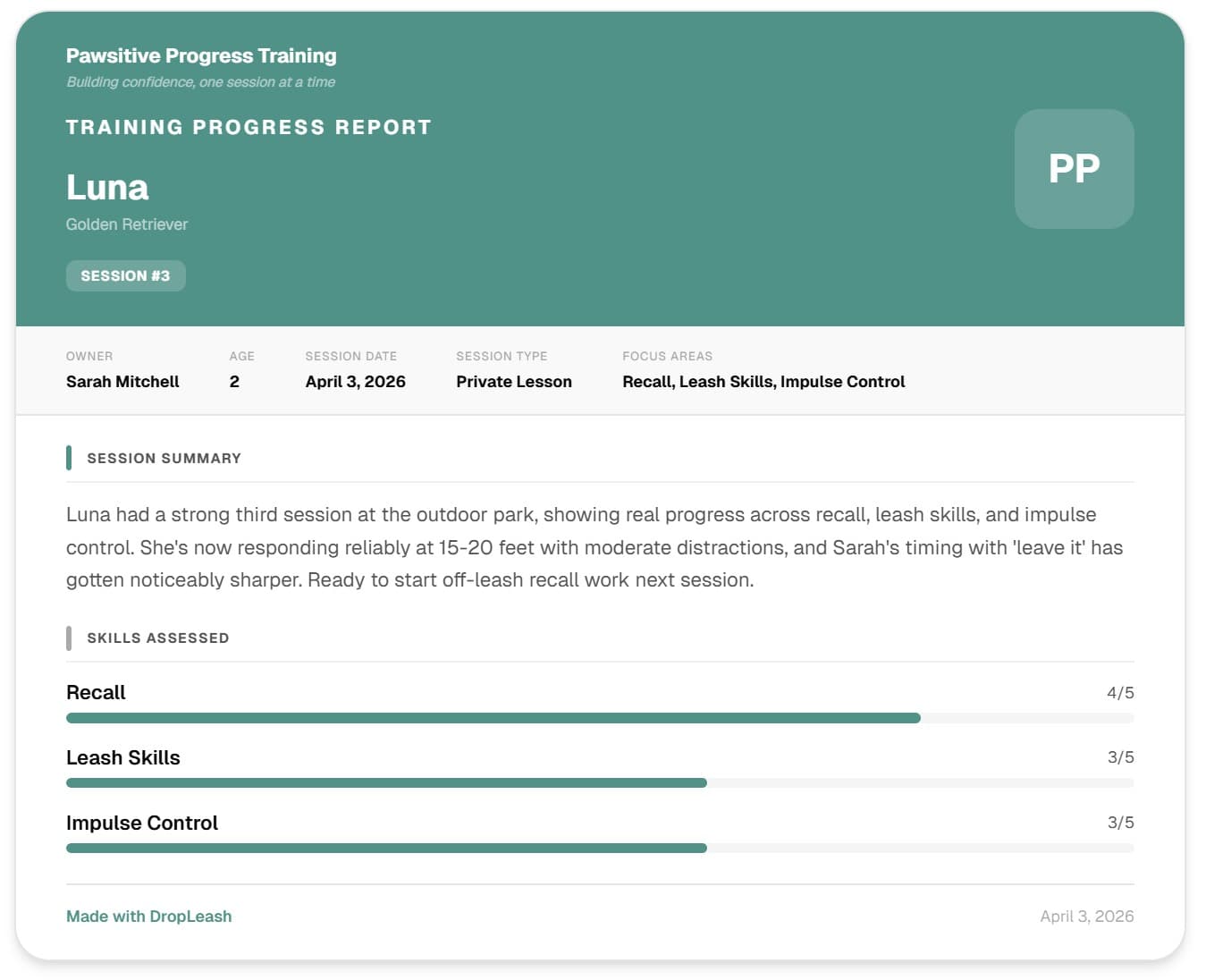
Your clients see your business name, your logo, your colors. They have no idea it took you 30 seconds instead of 30 minutes.
Stop writing reports from scratch
DropLeash generates professional, branded progress reports from your session notes. Your clients will think you spent hours on them.
Try It Free for 7 Days*DropLeash is a tool that helps dog trainers generate professional progress reports in seconds. We built DropLeash because we believe trainers should spend more of their time training dogs rather than writing about it. *